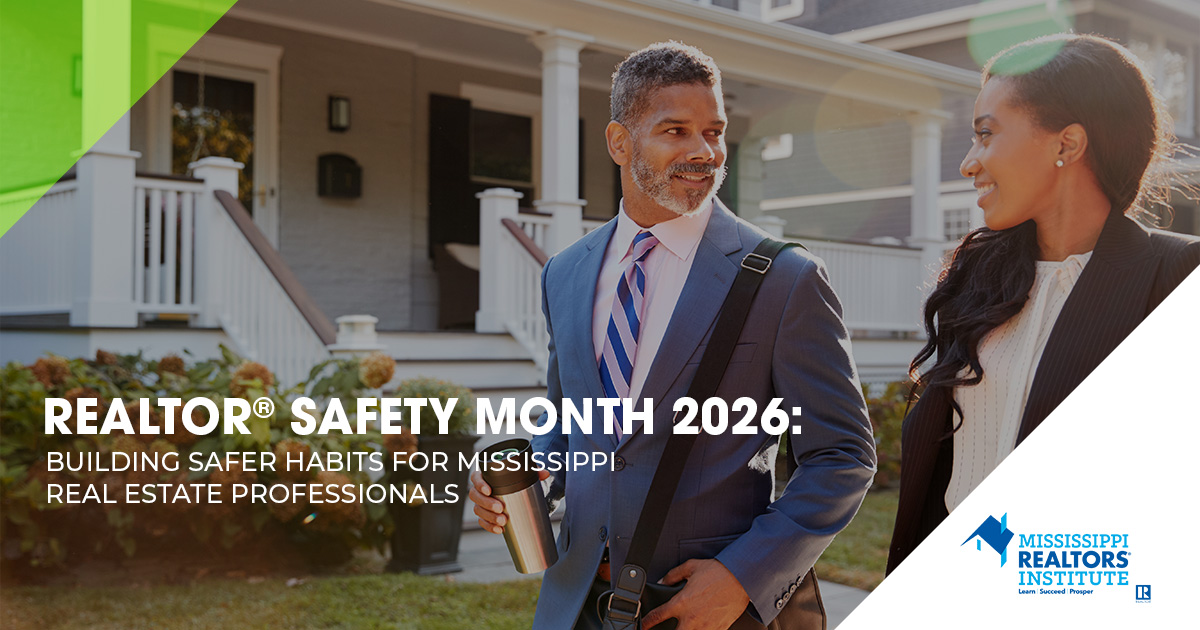
REALTOR® Safety Month 2026: Building Safer Habits for Mississippi Real Estate Professionals

Mississippi REALTOR® reviewing safety tips during REALTOR® Safety Month 2026

September is REALTOR® Safety Month, an annual reminder that safety should remain a priority for real estate professionals throughout the year. REALTORS® often work independently, meet new people, visit unfamiliar properties, host open houses, and manage communication across multiple platforms. These everyday responsibilities can create safety risks if clear precautions are not in place.

The National Association of REALTORS® dedicates September to safety awareness as part of its ongoing REALTOR® Safety Program. NAR explains that the program is designed to help members understand daily risks, stay aware of their surroundings, and use precautions that help reduce unsafe situations.

For Mississippi REALTORS®, Safety Month is a timely opportunity to review business practices, refresh office procedures, and strengthen habits that protect agents, clients, and communities.

Why Is REALTOR® Safety Important?

Real estate professionals face unique safety challenges because the job often involves meeting people outside of a traditional office setting.

REALTORS® may be asked to:

      • Show vacant properties
      • Meet prospects for the first time
      • Host open houses
      • Walk land or rural properties
      • Travel to unfamiliar locations
      • Share contact information online
      • Communicate through text, email, phone, and social media

While these activities are part of normal real estate practice, they require awareness and preparation. Safety planning helps REALTORS® reduce risk while continuing to provide professional service.

What Safety Steps Should REALTORS® Take Before Showings?

Before meeting a client or customer, REALTORS® should have a clear process in place.

Important safety steps may include:

      • Confirming the person’s identity
      • Meeting first-time prospects at the office or a public location when possible
      • Sharing appointment details with a broker, team member, or trusted contact
      • Keeping a charged phone available
      • Using a check-in system
      • Driving separately to showings
      • Avoiding isolated areas when possible
      • Trusting instincts if something feels wrong

These habits may seem simple, but consistency is what makes them effective. Safety planning should become part of the normal showing process, not something reserved only for unusual situations.

How Can REALTORS® Stay Safe During Open Houses?

Open houses can create additional safety concerns because multiple people may enter a property within a short period of time.

Before hosting an open house, REALTORS® should consider:

      • Reviewing all exits
      • Keeping personal belongings secured
      • Avoiding rooms where escape routes are limited
      • Asking visitors to sign in
      • Having another person present when possible
      • Letting someone know the open house schedule
      • Keeping valuables out of sight
      • Staying aware of who is inside the property

After the open house, REALTORS® should walk through the property carefully, make sure all visitors have left, lock doors and windows, and notify the seller of any concerns.

Why Is Digital Safety Part of REALTOR® Safety?

REALTOR® safety is not limited to in-person appointments. Digital safety also matters.

Real estate professionals often communicate through websites, email, social media, text messages, online advertising, and client management tools. This can increase exposure to scams, phishing attempts, suspicious inquiries, and privacy concerns.

Digital safety best practices may include:

      • Using strong passwords
      • Enabling multi-factor authentication
      • Avoiding suspicious links
      • Verifying wiring instructions through trusted channels
      • Protecting client information
      • Keeping business and personal accounts separate when possible
      • Reviewing privacy settings on social media
      • Being cautious when sharing real-time location details

Digital risk can impact both REALTORS® and their clients. Clear communication and verification procedures can help prevent confusion, fraud, and unnecessary exposure. MRI’s recent guidance on AI use, privacy, accuracy, and professional responsibility for Mississippi REALTORS® also provides additional information about managing technology responsibly in real estate practice.

How Can Brokerages Support REALTOR® Safety?

Safety should be part of the brokerage culture.

Brokers and office leaders can support safety by creating clear procedures, encouraging training, and making sure agents know what to do before, during, and after appointments.

Brokerage safety practices may include:

      • Written showing and open house procedures
      • Prospect screening policies
      • Check-in and check-out systems
      • Emergency contact protocols
      • Office training on safety scenarios
      • Cybersecurity reminders
      • Regular discussions during team meetings
      • Encouragement to report concerns

When safety is discussed regularly, agents are more likely to take precautions seriously and apply them consistently. Reviewing brokerage procedures and current Mississippi real estate requirements can also help offices maintain organized, consistent practices.

Why Should Safety Be a Year-Round Priority?

Although September highlights REALTOR® Safety Month, safety should remain a daily practice.

Real estate schedules can change quickly. A last-minute showing, unexpected visitor, unfamiliar location, or unusual request can create risk if REALTORS® are not prepared. Building safety into everyday routines helps professionals respond more confidently and avoid unnecessary vulnerability.

Safety also supports professionalism. Clients benefit when REALTORS® manage appointments, communication, property access, and transaction details with care and organization. Ongoing Code of Ethics and Fair Housing education can further reinforce the professional standards REALTORS® bring to client relationships and everyday business practices.

REALTOR® Safety Month FAQs

When is REALTOR® Safety Month?

REALTOR® Safety Month is observed in September each year as part of NAR’s ongoing commitment to safety awareness and education.

Why do REALTORS® need safety training?

REALTORS® often work alone, meet new people, enter unfamiliar properties, and share contact information publicly. Safety training helps professionals recognize risks and develop safer business habits.

What is one of the most important safety habits for showings?

One important habit is making sure someone knows where you are, who you are meeting, and when you expect to return or check in.

Should REALTORS® meet first-time prospects at a property?

When possible, REALTORS® may consider meeting first-time prospects at the office or in a public setting before going to a property. Brokerages should set procedures that align with safety best practices.

Does REALTOR® safety include cybersecurity?

Yes. Digital safety is an important part of professional risk management because REALTORS® handle sensitive information, communicate online, and may be targeted by scams or phishing attempts.

Make REALTOR® Safety a Daily Practice

REALTOR® Safety Month is an important reminder, but safety should not be limited to September. For Mississippi REALTORS®, building safer habits means preparing before appointments, communicating clearly, protecting client information, following brokerage procedures, and staying alert in both in-person and digital environments.

The Mississippi REALTORS® Institute supports real estate professionals through education and professional development opportunities that strengthen compliance, professionalism, communication, and industry awareness. By continuing to learn and apply best practices, REALTORS® can better protect themselves, their clients, and the reputation of the profession.

For continuing education courses, professional development opportunities, and MREC guidance updates, visit realtorinstitute.org or contact the Mississippi REALTORS® Institute at 601-932-5241. MRI remains your trusted resource for staying compliant, informed, and prepared in Mississippi real estate.

Useful Resources

Mississippi Real Estate Continuing Education Requirements: What REALTORS® Should Know in 2026

Mississippi real estate continuing education requirements for REALTORS® in 2026

Continuing education is an important part of maintaining a real estate license and staying prepared for changes in the industry. For Mississippi REALTORS®, CE is more than a renewal requirement. It is a way to stay informed, reduce compliance risk, strengthen client service, and continue building professional confidence.

Real estate laws, forms, disclosure expectations, technology, financing, agency relationships, fair housing responsibilities, and market conditions continue to evolve. As a result, ongoing education helps REALTORS® stay prepared for the questions and situations they may face in daily practice.

The Mississippi REALTORS® Institute offers education options designed to support real estate professionals at every stage of their careers, including pre-license, post-license, broker, continuing education, Code of Ethics/Fair Housing, online courses, and designation opportunities.How Many Continuing Education Hours Are Required in Mississippi?

Mississippi real estate licensees are generally required to complete 16 hours of approved continuing education during each renewal cycle. A new licensee’s first CE cycle begins when the permanent license is issued and lasts three years. Subsequent renewal cycles are two years.

MRI’s continuing education guidance explains that required education includes:

      • 2 hours of Contract Law
      • 2 hours of License Law
      • 4 hours of Agency Law
      • 8 hours of approved elective continuing education

Because requirements, course availability, and renewal timelines can vary depending on license status and individual circumstances, REALTORS® should always confirm their current standing with the Mississippi Real Estate Commission and plan ahead before renewal deadlines.

Why Is Continuing Education Important for REALTORS®?

Continuing education helps REALTORS® stay current in an industry where small changes can have a major impact.

Education can help licensees better understand:

      • Mississippi license law and MREC procedures
      • Agency relationships and disclosure responsibilities
      • Contract updates and transaction best practices
      • Fair housing requirements
      • Ethical responsibilities
      • Risk management
      • Technology and advertising considerations
      • Client communication strategies

When REALTORS® stay informed, they are better equipped to answer questions, explain processes clearly, and guide clients through important decisions.

What Types of CE Courses Are Available Through MRI?

The Mississippi REALTORS® Institute offers multiple course options to help professionals fit education into their schedules.

MRI’s site highlights in-person continuing education, online CE, Code of Ethics/Fair Housing, and other professional development opportunities. MRI also emphasizes a flexible “wherever, whenever” approach with in-person, virtual, and online learning options.

Common education options may include:

      • In-person CE classes
      • Online self-paced courses
      • Virtual learning opportunities
      • Code of Ethics and Fair Housing training
      • GRI and designation-related education
      • Exam review and licensing courses

This flexibility makes it easier for REALTORS® to complete required education while balancing client appointments, closings, showings, and daily business responsibilities.

Why Should REALTORS® Plan CE Before Renewal Deadlines?

Waiting until the last minute can create unnecessary stress.

By planning ahead, REALTORS® can:

      • Choose courses that fit their schedule
      • Avoid deadline pressure
      • Make sure required topics are completed
      • Confirm course credit is properly reported
      • Leave time to resolve any record or renewal issues
      • Select courses that align with their professional goals

Planning early can also allow REALTORS® to choose education that is truly useful, rather than simply selecting whatever course is available at the last minute.

How Does Continuing Education Support Client Service?

Clients rely on REALTORS® for guidance, communication, and professional insight. Continuing education helps REALTORS® stay prepared to explain important topics clearly and accurately.

CE can strengthen client service by helping REALTORS®:

      • Communicate agency relationships clearly
      • Explain contract timelines and responsibilities
      • Recognize potential compliance concerns
      • Understand fair housing responsibilities
      • Navigate changing market conditions
      • Provide more organized transaction guidance
      • Refer clients to qualified professionals when needed

In a competitive real estate environment, knowledge is a professional advantage. REALTORS® who invest in education are often better positioned to build trust and deliver a stronger client experience.

What Is the Difference Between CE and Post-License Education?

Continuing education and post-license education are not the same.

Post-license education applies to new licensees after they receive a temporary salesperson’s license. MRI’s Salesperson Post-License program states that individuals must complete a 30-hour post-license course within 12 months after being issued the temporary salesperson’s license.

Continuing education, on the other hand, applies to ongoing license renewal requirements after the initial licensing period. REALTORS® should understand which requirement applies to their current license status and confirm deadlines with MREC when needed.

Continuing Education FAQs for Mississippi REALTORS®

How often do Mississippi REALTORS® need continuing education?

Mississippi real estate licensees complete continuing education as part of each renewal cycle. A new licensee’s first CE cycle begins when the permanent license is issued and lasts three years. Subsequent renewal cycles are two years.

Can Mississippi real estate continuing education be completed online?

Yes. MRI offers online continuing education options, allowing real estate professionals to complete coursework with greater flexibility.

What topics are included in Mississippi CE?

CE includes required law topics, including License Law, Contract Law, and Agency Law, along with approved elective courses that support professional development.

Does Code of Ethics training count as continuing education?

Code of Ethics/Fair Housing classes may provide education credit depending on course approval and individual requirements. REALTORS® should review course details and confirm credit requirements before enrolling.

Where can REALTORS® find upcoming CE courses?

Mississippi REALTORS® can review MRI’s courses and continuing education opportunities for available in-person, virtual, and online course options.

Staying Compliant and Competitive Through Education

Continuing education is one of the most practical ways REALTORS® can protect their license, strengthen their skills, and stay prepared for changes in Mississippi real estate.

As laws, technology, forms, financing, and consumer expectations continue to evolve, REALTORS® who prioritize education are better equipped to serve clients with professionalism and confidence.

The Mississippi REALTORS® Institute provides Mississippi-focused education designed to help real estate professionals stay compliant, informed, and prepared. With flexible in-person continuing education and online learning opportunities, MRI helps REALTORS® complete required education while continuing to grow their knowledge and expertise.

For continuing education courses, MREC guidance updates, and professional development resources, visit realtorinstitute.org or contact the Mississippi REALTORS® Institute at 601-932-5241. MRI remains your trusted resource for staying compliant, informed, and prepared in Mississippi real estate.

Useful Resources

AI Guidelines for Mississippi REALTORS®: What Licensees Should Know in 2026

Artificial intelligence is becoming a common tool in real estate. From listing descriptions and marketing ideas to client communication, document review, photo editing, and market research, AI can help real estate professionals work more efficiently.

However, AI also creates new risks for accuracy, privacy, disclosure, valuation, and compliance. In June 2026, the Mississippi Real Estate Commission released guidance on the use of artificial intelligence tools by real estate licensees. The guidance reminds licensees that while AI may be useful, professional responsibility remains with the licensee using the tool.

For Mississippi REALTORS®, this is an important opportunity to review how AI is being used in daily business practices and to make sure technology supports professionalism, rather than replacing judgment, verification, and ethical decision-making.

What Did MREC Say About AI Use in Real Estate?

MREC’s June 2026 AI guidance explains that AI tools may be helpful, but they do not change a licensee’s legal duties or responsibilities. Licensees remain accountable for their real estate activity and work product, even when an AI tool is involved.

This means REALTORS® should treat AI as an assistant, not as a final decision-maker. AI-generated content should be reviewed carefully before it is shared with clients, customers, brokers, the public, or other professionals involved in a transaction.

Examples of AI use in real estate may include:

· Drafting listing descriptions
· Creating marketing captions
· Editing or enhancing property photos
· Summarizing documents
· Preparing client communication
· Researching general real estate topics
· Reviewing business workflows

While these tools may save time, they can also produce inaccurate, incomplete, misleading, or fabricated information if not reviewed carefully.

Why Is Accuracy So Important When Using AI?

Accuracy is one of the biggest concerns with AI-generated real estate content.

MREC notes that AI may exaggerate, fabricate information, or “hallucinate” when creating text, editing photos, or analyzing documents. In a real estate setting, inaccurate information can create serious problems.

For example, AI-generated content could incorrectly describe:

· Property features
· Square footage or lot details
· Renovations or improvements
· Neighborhood information
· Financing or legal requirements
· Contract terms
· Market conditions

Even if the mistake came from AI, the licensee may still be held accountable. Before using AI-generated work product, REALTORS® should verify facts, confirm property details, review documents, and make sure all statements are accurate and appropriate.

How Can AI Affect Client Privacy and Confidentiality?

Privacy is another major issue for real estate professionals using AI.

MREC cautions that client or customer information entered into an AI platform may be retained or used by that platform. Licensees are encouraged to carefully review platform terms and avoid entering personally identifiable information unless it has been fully disclosed and informed consent has been obtained.

Personally identifiable information may include details such as:

· Name
· Date of birth
· Social Security number
· Address
· Phone number
· Email address
· Income estimates
· Other private or sensitive information

REALTORS® should also be careful when uploading contracts, brokerage documents, internal files, or proprietary business information into AI tools. Even when AI is used for convenience, protecting client confidentiality must remain a priority.

What Should Brokers Know About AI Use?

Principal brokers have supervisory responsibilities for the work of their agents. MREC’s guidance specifically notes that brokers should be aware of whether and how agents are using AI, and it recommends establishing an AI use policy.

A brokerage AI policy may help clarify:

· Which AI tools may be used
· What information should never be entered into AI platforms
· When broker review is required
· How AI-generated marketing should be checked
· How client consent should be handled
· How edited images or AI-assisted content should be disclosed

Clear office procedures can help reduce confusion and create more consistent standards across a brokerage.

Can REALTORS® Use AI for Pricing or Valuation?

AI-powered valuation tools and automated valuation models can provide general estimates, but they should not replace professional judgment.

MREC explains that automated valuation models use algorithms and statistical modeling, but they may lack local context and cannot fully assess property condition, neighborhood atmosphere, or recent unrecorded renovations.

For Mississippi REALTORS®, this is especially important because real estate is local. Pricing guidance should consider market conditions, comparable sales, property condition, location, buyer demand, and other factors that may not be fully captured by AI.

Overreliance on AI for pricing discussions or negotiations may create risk for licensees. REALTORS® should use AI carefully and avoid presenting automated estimates as a substitute for professional analysis.

Why Should REALTORS® Avoid Using AI for Legal Advice?

AI should not be relied on for legal answers, contract interpretation, or legal advice.

MREC’s guidance warns that using AI for legal opinions or legal review could expose a licensee to significant liability. Real estate transactions often involve complex legal questions, and licensees should avoid stepping outside the scope of their role.

When legal questions arise, REALTORS® should encourage clients to seek advice from a qualified attorney.

AI Use FAQs for Mississippi REALTORS®

Can Mississippi REALTORS® use AI in their real estate business?

Yes. AI can be used as a helpful tool, but REALTORS® should carefully review AI-generated work for accuracy, avoid entering sensitive client information, and follow brokerage policies and applicable real estate requirements.

Who is responsible if AI creates inaccurate real estate content?

The licensee remains responsible for their real estate activity and work product. AI use does not excuse errors, misrepresentations, or failure to verify information.

Should brokers create an AI policy?

Yes. MREC recommends that brokers be aware of how agents are using AI and consider establishing an AI use policy for the brokerage.

Can AI write listing descriptions?

AI may assist with drafting listing descriptions, but REALTORS® should verify all property details, remove unsupported claims, and make sure the final content is accurate and compliant.

Can AI be used to edit real estate photos?

AI photo editing should be handled carefully. REALTORS® should avoid edits that misrepresent the property and should follow applicable disclosure and advertising standards.

Using AI Responsibly in Mississippi Real Estate

Artificial intelligence will likely continue shaping the way real estate professionals communicate, market properties, organize information, and serve clients. Used responsibly, AI can support efficiency and creativity. Used carelessly, it can create risk.

For Mississippi REALTORS®, the key is balance. AI should support professional judgment, not replace it. Licensees should verify information, protect client confidentiality, understand broker expectations, avoid unauthorized legal guidance, and stay informed as technology and regulatory guidance continue to evolve.

The Mississippi REALTORS® Institute provides Mississippi-focused education designed to help real estate professionals stay informed, compliant, and prepared for changes impacting the industry. Through in-person, virtual, and online learning opportunities, MRI helps REALTORS® strengthen their knowledge and apply best practices in real-world scenarios.

For continuing education courses, MREC guidance updates, and professional development resources, visit realtorinstitute.org or contact the Mississippi REALTORS® Institute at 601-932-5241. MRI remains your trusted resource for staying compliant, informed, and prepared in Mississippi real estate.

Useful Resources

· Mississippi Real Estate Commission – MREC AI Guidelines, June 2026
· Mississippi Real Estate Commission – News, Events, and Policies
· Mississippi REALTORS® Institute – Continuing Education Courses

Fair Housing in 2026: Key Updates and Education Opportunities for Mississippi REALTORS®

Mississippi REALTORS® attending fair housing education training in 2026

Fair housing remains a cornerstone of ethical and compliant real estate practice. In 2026, Mississippi REALTORS® must go beyond awareness and focus on active application, risk management, and ongoing education to meet evolving industry expectations.

As regulations, technology, and client demographics continue to shift, staying informed is essential not only to remain compliant, but also to build trust and serve communities effectively across Mississippi.

What Is the Fair Housing Act and Why Does It Matter in Real Estate?

The Fair Housing Act of 1968 prohibits discrimination in housing based on race, color, religion, sex, national origin, disability, and familial status. These protections apply to every stage of a real estate transaction, including listing, advertising, financing, and client communication.

For Mississippi REALTORS®, this law directly impacts daily business practices. From how properties are marketed to how clients are guided through decisions, every interaction must reflect fairness and consistency.

Failure to comply can result in serious consequences, including investigations by the Mississippi Real Estate Commission (MREC) or the U.S. Department of Housing and Urban Development (HUD), along with potential legal and financial penalties.

More importantly, fair housing compliance strengthens professionalism and reinforces public trust, which are key factors in long-term success.

What Fair Housing Issues Should REALTORS® Pay Attention to in 2026?

Fair housing challenges continue to evolve alongside the real estate industry. In 2026, REALTORS® should be especially aware of:

AI and automated marketing tools
Technology is playing a larger role in listing descriptions and advertising. AI-generated content can unintentionally introduce biased language, making careful review essential.

Source-of-income considerations
Discussions around income sources, including housing assistance programs, are gaining increased attention. REALTORS® must understand how these factors intersect with fair housing guidance.

Expanded interpretations of protections
Ongoing guidance from the National Association of REALTORS® and federal agencies continues to reinforce protections related to sexual orientation and gender identity.

Advertising language risks
Phrases such as “perfect for young professionals” or “ideal for empty nesters” can raise compliance concerns. Neutral, inclusive language is critical in all marketing efforts.

By staying ahead of these issues, REALTORS® can reduce risk while better serve a diverse and growing client base.


Why Is Fair Housing Education Important for Mississippi REALTORS®?

Education remains one of the most effective ways to prevent fair housing violations and strengthen professional confidence.

As of 2025, NAR requires all members to complete two hours of fair housing training every three years, aligning with the Code of Ethics cycle. This requirement reflects a broader industry commitment to accountability and equitable practices.

Beyond meeting requirements, continuing education helps REALTORS®:

  • Recognize and address implicit bias
  • Navigate complex client scenarios
  • Apply fair housing laws consistently in real-world situations

Mississippi REALTORS® can also explore additional tools and guidance through the National Association of REALTORS® Fair Housing resources, which provide valuable insights into current standards and best practices.

For professionals across the state, localized education ensures these national principles are applied effectively within Mississippi’s unique market conditions.


How Does MRI Support Fair Housing Education in Mississippi?

The Mississippi REALTORS® Institute (MRI) provides ongoing education designed to help real estate professionals strengthen their understanding of fair housing laws through practical, real-world learning.

MRI’s fair housing training focuses on helping REALTORS® apply key principles in their day-to-day business, including:

  • Identifying and addressing bias in transactions
  • Understanding current compliance risks and trends
  • Applying fair housing principles in marketing and client interactions

Through interactive coursework and expert-led instruction, REALTORS® gain actionable strategies they can immediately apply to better serve clients and reduce compliance risks.

With in-person, virtual, and online options available, Mississippi REALTORS® can access training that fits their schedule while staying aligned with industry expectations.

REALTORS® can also strengthen their knowledge through national resources from the National Association of REALTORS®, including the Fair Housing Action Plan (ACT!), which focuses on accountability, culture change, and training to advance fair housing practices across the industry.

In addition to supporting continuing education requirements, MRI’s fair housing training provides valuable opportunities for professional growth while reinforcing a shared commitment to ethical real estate practice across Mississippi.

How Can REALTORS® Stay Compliant With Fair Housing Laws and Best Practices?

Staying compliant requires a proactive and consistent approach. REALTORS® can strengthen their fair housing practices by:

Auditing marketing materials regularly
Ensure all advertising uses inclusive, neutral language and avoids references to protected classes.

Documenting client interactions
Maintaining clear records helps demonstrate consistent, non-discriminatory practices.

Completing required and ongoing education
Take advantage of training opportunities through MRI and industry resources to stay current.

Monitoring industry updates
Fair housing guidance continues to evolve, making it essential to stay informed on regulatory changes and best practices.

Partnering with trusted education providers
Working with the Mississippi REALTORS® Institute ensures access to relevant, high-quality training tailored to Mississippi professionals.


Fair Housing FAQs for Mississippi REALTORS®

What is fair housing in real estate?

Fair housing refers to laws that prohibit discrimination in housing based on protected characteristics such as race, religion, sex, disability, and more.

Why is fair housing important for Mississippi REALTORS®?

It helps REALTORS® remain compliant, serve clients ethically, and promote equal access to housing across Mississippi.

What fair housing issues should REALTORS® watch in 2026?

Key concerns include AI-generated content, advertising language, implicit bias, and evolving guidance on protected classes.

Are REALTORS® required to complete fair housing training?

Yes. NAR requires two hours of fair housing training every three years as part of the Code of Ethics cycle.

How can REALTORS® avoid fair housing violations?

Use inclusive language, document interactions, complete training, and stay updated on fair housing guidance.

Where can Mississippi REALTORS® find fair housing education?

Mississippi REALTORS® can find fair housing education through the Mississippi REALTORS® Institute, which offers courses and training opportunities throughout the year across the state, as well as online and virtual options. 

Lead With Fair Housing Knowledge in 2026

Fair housing knowledge is no longer optional. It is a critical part of staying compliant and competitive in today’s real estate environment.

The Mississippi REALTORS® Institute provides Mississippi-specific training designed to help REALTORS® confidently navigate fair housing requirements, recognize potential risks, and apply best practices in real-world scenarios. With in-person, virtual, and online options, professionals can stay current while strengthening their ability to serve clients ethically and effectively.

In today’s market, success is not just about closing transactions. It is about doing so with integrity, consistency, and a strong understanding of fair housing principles. For continuing education courses, fair housing training, and upcoming events like the Fair Housing Fair, visit realtorinstitute.org or contact the Mississippi REALTORS® Institute at 601-932-5241. MRI remains your trusted resource for staying compliant, informed, and prepared in Mississippi real estate.


Useful Resources

LET'S BE SOCIAL

Instagram_icon
Facebook_Logo_2023
YouTube Logo
LinkedIn
twitter-x-logo-png_seeklogo-492396
Mississippi Realtors Institute logo
Mississippi Realtors logo

Tel: 601-932-5241 / E-mail: mri@msrealtors.org / 4274 Lakeland Drive • Flowood, MS • 39232

CopyrightⒸ 2026 Mississippi REALTORS® Institute - All Rights Reserved