AI Guidelines for Mississippi REALTORS®: What Licensees Should Know in 2026

Artificial intelligence is becoming a common tool in real estate. From listing descriptions and marketing ideas to client communication, document review, photo editing, and market research, AI can help real estate professionals work more efficiently.

However, AI also creates new risks for accuracy, privacy, disclosure, valuation, and compliance. In June 2026, the Mississippi Real Estate Commission released guidance on the use of artificial intelligence tools by real estate licensees. The guidance reminds licensees that while AI may be useful, professional responsibility remains with the licensee using the tool.

For Mississippi REALTORS®, this is an important opportunity to review how AI is being used in daily business practices and to make sure technology supports professionalism, rather than replacing judgment, verification, and ethical decision-making.

What Did MREC Say About AI Use in Real Estate?

MREC’s June 2026 AI guidance explains that AI tools may be helpful, but they do not change a licensee’s legal duties or responsibilities. Licensees remain accountable for their real estate activity and work product, even when an AI tool is involved.

This means REALTORS® should treat AI as an assistant, not as a final decision-maker. AI-generated content should be reviewed carefully before it is shared with clients, customers, brokers, the public, or other professionals involved in a transaction.

Examples of AI use in real estate may include:

· Drafting listing descriptions
· Creating marketing captions
· Editing or enhancing property photos
· Summarizing documents
· Preparing client communication
· Researching general real estate topics
· Reviewing business workflows

While these tools may save time, they can also produce inaccurate, incomplete, misleading, or fabricated information if not reviewed carefully.

Why Is Accuracy So Important When Using AI?

Accuracy is one of the biggest concerns with AI-generated real estate content.

MREC notes that AI may exaggerate, fabricate information, or “hallucinate” when creating text, editing photos, or analyzing documents. In a real estate setting, inaccurate information can create serious problems.

For example, AI-generated content could incorrectly describe:

· Property features
· Square footage or lot details
· Renovations or improvements
· Neighborhood information
· Financing or legal requirements
· Contract terms
· Market conditions

Even if the mistake came from AI, the licensee may still be held accountable. Before using AI-generated work product, REALTORS® should verify facts, confirm property details, review documents, and make sure all statements are accurate and appropriate.

How Can AI Affect Client Privacy and Confidentiality?

Privacy is another major issue for real estate professionals using AI.

MREC cautions that client or customer information entered into an AI platform may be retained or used by that platform. Licensees are encouraged to carefully review platform terms and avoid entering personally identifiable information unless it has been fully disclosed and informed consent has been obtained.

Personally identifiable information may include details such as:

· Name
· Date of birth
· Social Security number
· Address
· Phone number
· Email address
· Income estimates
· Other private or sensitive information

REALTORS® should also be careful when uploading contracts, brokerage documents, internal files, or proprietary business information into AI tools. Even when AI is used for convenience, protecting client confidentiality must remain a priority.

What Should Brokers Know About AI Use?

Principal brokers have supervisory responsibilities for the work of their agents. MREC’s guidance specifically notes that brokers should be aware of whether and how agents are using AI, and it recommends establishing an AI use policy.

A brokerage AI policy may help clarify:

· Which AI tools may be used
· What information should never be entered into AI platforms
· When broker review is required
· How AI-generated marketing should be checked
· How client consent should be handled
· How edited images or AI-assisted content should be disclosed

Clear office procedures can help reduce confusion and create more consistent standards across a brokerage.

Can REALTORS® Use AI for Pricing or Valuation?

AI-powered valuation tools and automated valuation models can provide general estimates, but they should not replace professional judgment.

MREC explains that automated valuation models use algorithms and statistical modeling, but they may lack local context and cannot fully assess property condition, neighborhood atmosphere, or recent unrecorded renovations.

For Mississippi REALTORS®, this is especially important because real estate is local. Pricing guidance should consider market conditions, comparable sales, property condition, location, buyer demand, and other factors that may not be fully captured by AI.

Overreliance on AI for pricing discussions or negotiations may create risk for licensees. REALTORS® should use AI carefully and avoid presenting automated estimates as a substitute for professional analysis.

Why Should REALTORS® Avoid Using AI for Legal Advice?

AI should not be relied on for legal answers, contract interpretation, or legal advice.

MREC’s guidance warns that using AI for legal opinions or legal review could expose a licensee to significant liability. Real estate transactions often involve complex legal questions, and licensees should avoid stepping outside the scope of their role.

When legal questions arise, REALTORS® should encourage clients to seek advice from a qualified attorney.

AI Use FAQs for Mississippi REALTORS®

Can Mississippi REALTORS® use AI in their real estate business?

Yes. AI can be used as a helpful tool, but REALTORS® should carefully review AI-generated work for accuracy, avoid entering sensitive client information, and follow brokerage policies and applicable real estate requirements.

Who is responsible if AI creates inaccurate real estate content?

The licensee remains responsible for their real estate activity and work product. AI use does not excuse errors, misrepresentations, or failure to verify information.

Should brokers create an AI policy?

Yes. MREC recommends that brokers be aware of how agents are using AI and consider establishing an AI use policy for the brokerage.

Can AI write listing descriptions?

AI may assist with drafting listing descriptions, but REALTORS® should verify all property details, remove unsupported claims, and make sure the final content is accurate and compliant.

Can AI be used to edit real estate photos?

AI photo editing should be handled carefully. REALTORS® should avoid edits that misrepresent the property and should follow applicable disclosure and advertising standards.

Using AI Responsibly in Mississippi Real Estate

Artificial intelligence will likely continue shaping the way real estate professionals communicate, market properties, organize information, and serve clients. Used responsibly, AI can support efficiency and creativity. Used carelessly, it can create risk.

For Mississippi REALTORS®, the key is balance. AI should support professional judgment, not replace it. Licensees should verify information, protect client confidentiality, understand broker expectations, avoid unauthorized legal guidance, and stay informed as technology and regulatory guidance continue to evolve.

The Mississippi REALTORS® Institute provides Mississippi-focused education designed to help real estate professionals stay informed, compliant, and prepared for changes impacting the industry. Through in-person, virtual, and online learning opportunities, MRI helps REALTORS® strengthen their knowledge and apply best practices in real-world scenarios.

For continuing education courses, MREC guidance updates, and professional development resources, visit realtorinstitute.org or contact the Mississippi REALTORS® Institute at 601-932-5241. MRI remains your trusted resource for staying compliant, informed, and prepared in Mississippi real estate.

Useful Resources

· Mississippi Real Estate Commission – MREC AI Guidelines, June 2026
· Mississippi Real Estate Commission – News, Events, and Policies
· Mississippi REALTORS® Institute – Continuing Education Courses
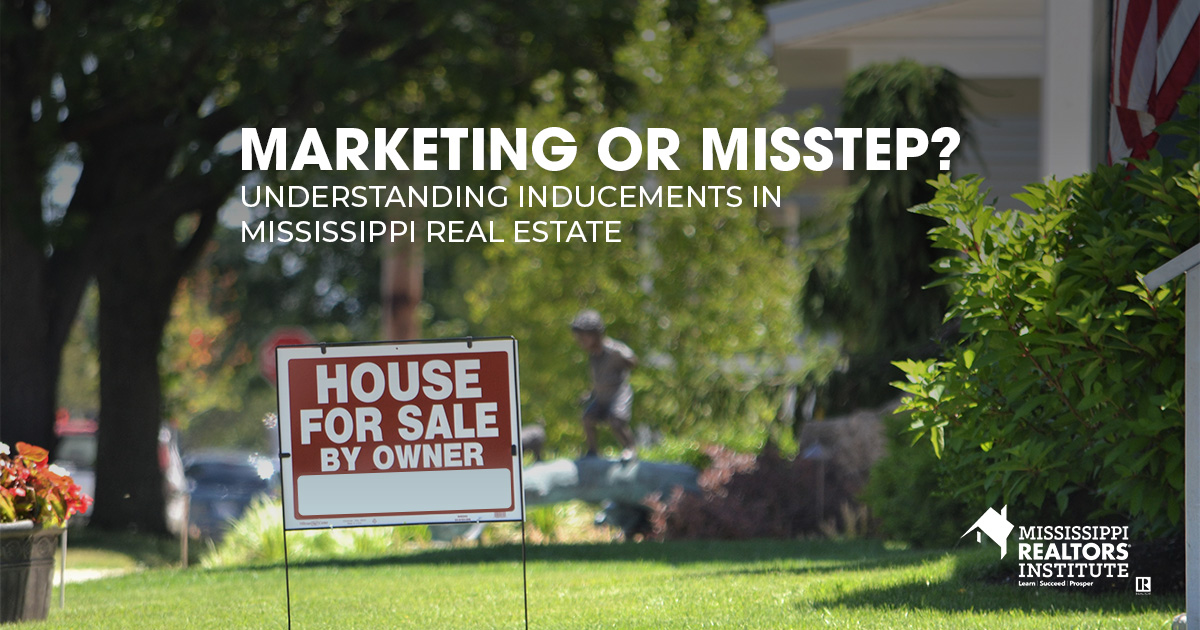
Marketing or Misstep? Understanding Inducements in Mississippi Real Estate

In Mississippi real estate, there is a fine line between effective marketing and improper inducement. While promoting your services is essential to business growth, encouraging a client to break an existing agreement can quickly cross into unethical—and even unlawful—territory.

Guidance from the Mississippi Real Estate Commission and the National Association of REALTORS® (NAR) makes it clear: protecting consumers and respecting contractual relationships is not optional. For Mississippi REALTORS®, understanding inducements is key to maintaining compliance, protecting your license, and building long-term trust.

What Is Considered an Inducement in Mississippi Real Estate?

An inducement is anything offered to persuade a client or customer to take action that benefits a real estate professional. This can include:

  • Cash bonuses
  • Gifts or prizes
  • Discounts on commission
  • Special perks tied to representation

On its own, an inducement is not always improper. The issue arises when the incentive is used to influence someone to break an existing agreement or act against their contractual obligations.

According to the National Association of REALTORS® Code of Ethics (Article 16), REALTORS® must not engage in practices inconsistent with another broker’s exclusive agreement. This principle ensures fairness, transparency, and respect across the industry.


For further reference, see:

  • National Association of REALTORS® – Code of Ethics
  • Mississippi Real Estate Commission – License Law

Can a REALTOR® Contact a Seller Who Already Has a Listing Agreement?

This is one of the most common compliance questions among Mississippi agents.

The short answer: proceed with caution.

General marketing—such as mailers, digital ads, or social media campaigns—is typically acceptable because it is not directed at a specific individual. However, targeted solicitation of a seller known to be under an active listing agreement can violate ethical standards.


The distinction lies in intent:

  • Permissible: Broad, non-targeted marketing
  • Risky: Direct outreach encouraging a seller to cancel an existing agreement

For more detail, see NAR’s Article 16 case interpretations, which help explain how REALTORS® should avoid interfering with existing exclusive agreements.

Mississippi REALTORS® should always prioritize professionalism and avoid any communication that could be interpreted as contract interference.

What Are Examples of Improper Inducements in Real Estate?

Improper inducements often appear harmless but can lead to serious consequences. Common examples include:

  • Offering a financial incentive for terminating another broker’s listing
  • Promising perks in exchange for switching representation
  • Encouraging clients to ignore contractual obligations
  • Using direct messaging to pressure represented clients
  • Advertising incentives without clear terms and disclosures


According to the Federal Trade Commission (FTC), marketing practices must also be truthful and non-deceptive—adding another layer of compliance for real estate professionals. Agents can strengthen their knowledge through the Institute’s course descriptions and continuing education options, including online and in-person classes.

The key takeaway: if the strategy could influence someone to violate a contract, it is likely an ethical misstep.

Real estate agent explaining a contract to a client during a professional consultation

How Do Mississippi Real Estate Laws Address Contract Interference?

Mississippi real estate law emphasizes the importance of honoring written agreements, including:

  • Exclusive listing agreements
  • Buyer representation agreements

These are legally binding contracts—not informal arrangements.

The Mississippi Real Estate Commission (MREC) has the authority to investigate complaints and discipline licensees who engage in improper conduct, including contract interference.The Mississippi Real Estate Commission Rules and Regulations also set standards for licensee conduct, advertising, and disclosure.

Violations may result in:

  • Fines
  • License suspension
  • Mandatory education or disciplinary action

This reinforces an important point: inducement violations are not just ethical concerns—they can become licensing issues with real consequences.

How Can REALTORS® Avoid Inducement Violations in Mississippi?

Avoiding inducement violations starts with intentional, ethical business practices. Mississippi REALTORS® should:

  1. Verify Representation Status
    Always confirm whether a client is already under contract before initiating direct communication.
  2. Keep Marketing General and Professional
    Focus on broad messaging rather than targeting individuals under agreement.
  3. Be Transparent With Incentives
    Clearly disclose all terms, conditions, and limitations of any promotion.
  4. Respect Existing Agreements
    Never suggest that breaking a contract is easy, beneficial, or encouraged.
  5. Seek Guidance When Needed
    Consult your broker or review MREC, NAR, and the Frequently Asked Questions on the Mississippi REALTORS® Institute website when situations are unclear.

Why Understanding Inducements Matters for Mississippi REALTORS®

As emphasized in recent MRI guidance , professionalism in Mississippi real estate is built on more than sales skills—it requires ethical decision-making, compliance awareness, and clear communication.

Understanding inducements helps REALTORS®:

  • Protect their license
  • Reduce risk of complaints
  • Build client trust
  • Maintain a strong professional reputation 

Protecting Your Business Through Ongoing Education

This is exactly where continuing education becomes a competitive advantage.

The Mississippi REALTORS® Institute provides Mississippi-specific training designed to help agents navigate real-world compliance scenarios like inducements, contract interference, and ethical marketing. With in-person, virtual, and online options, REALTORS® can stay current while strengthening their business practices.

In today’s market, success isn’t just about generating leads—it’s about doing so ethically, legally, and professionally. For continuing education courses, Code of Ethics training, and additional professional development resources, visit realtorinstitute.org or contact the Mississippi REALTORS® Institute at 601-932-5241—your resource for staying compliant, informed, and competitive in Mississippi real estate.

How Mississippi REALTORS® Can Use NAR Consumer Guides to Strengthen Client Communication in 2026

Mississippi REALTOR® discussing NAR Consumer Guides with homebuyers during a client consultation in 2026.

Clear communication is one of the most valuable services REALTORS® provide to buyers and sellers. In today’s market, clients are more informed than ever—but they are also exposed to misinformation online. Mississippi REALTORS® who lead conversations with clarity and documentation are better positioned to build trust and prevent misunderstandings before they affect a transaction.

The Consumer Guide series developed by the National Association of REALTORS® provides professionally written, consumer-friendly resources that explain key real estate concepts such as written buyer agreements, appraisal gaps, closing costs, multiple-offer situations, and agency relationships.

When used strategically, these guides can enhance listing presentations, strengthen buyer consultations, and reinforce professionalism throughout 2026.

What Are NAR Consumer Guides and How Do REALTORS® Use Them?
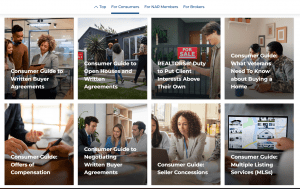
Grid of National Association of REALTORS® Consumer Guides covering written buyer agreements, open houses, REALTOR® duties, veteran homebuying, offers of compensation, negotiating agreements, seller concessions, and MLS services.

NAR Consumer Guides are concise, plain-language resources designed to help REALTORS® explain important real estate topics clearly and consistently. Each guide focuses on a specific subject and outlines what buyers or sellers should understand before making decisions.

Topics include:

  • Written buyer agreements
  • Open houses
  • Offers of compensation
  • Multiple-offer scenarios
  • Appraisal gaps
  • Closing costs
  • Preparing to buy or sell

These guides support transparent communication and align with the REALTOR® Code of Ethics by reinforcing accurate, non-misleading explanations.

How Mississippi REALTORS® Can Use Them

Mississippi REALTORS® can integrate Consumer Guides into their workflow in several practical ways:

  • Provide a relevant guide during initial buyer or listing consultations
  • Send the applicable PDF as a follow-up after discussing complex topics
  • Include printed copies in listing packets or buyer folders
  • Use the guide as a reference point during agency discussions
  • Share educational posts tied to guide topics on social media

When clients both hear an explanation and receive a written resource, comprehension improves and expectations become clearer.

Mississippi REALTOR® meeting with homebuyers and shaking hands after discussing buyer representation and real estate services.

How Can REALTORS® Better Educate Buyers and Sellers in 2026?

In 2026, consumers expect responsiveness, documentation, and transparency— trends consistently reflected in national consumer research. Real estate professionals who proactively explain processes and provide written resources demonstrate both competence and professionalism.

Mississippi REALTORS® can elevate client education by:

  • Explaining agency relationships early and clearly
  • Discussing compensation structures before offers are written
  • Reviewing contingencies and timelines in plain language
  • Providing written resources to reinforce conversations

While NAR Consumer Guides provide a national foundation, REALTORS® must ensure those explanations reflect Mississippi license law and regulatory standards enforced by the Mississippi Real Estate Commission.

Ongoing professional education ensures that communication remains accurate, compliant, and aligned with current practice standards.

Can Mississippi REALTORS® Share NAR Consumer Guides With Clients?

Yes. NAR developed Consumer Guides specifically for REALTORS® to use in client communication.

Mississippi REALTORS® may:

  • Download available English and Spanish versions
  • Attach PDFs to post-consultation emails
  • Incorporate them into digital marketing or drip campaigns
  • Provide printed copies at open houses
  • Reference guide content during listing presentations

Because these materials are created by the National Association of REALTORS®, they support consistent messaging and reinforce the professionalism associated with REALTOR® membership.

As with all communication tools, REALTORS® should ensure their use aligns with brokerage policies and Mississippi regulations.

How Do Consumer Guides Help Prevent Real Estate Misunderstandings?

Many transaction challenges stem from unclear expectations rather than disputes.

Common areas where misunderstandings occur include:

  • Representation and agency obligations
  • Compensation explanations
  • Earnest money and escrow procedures
  • Multiple-offer strategies
  • Inspection and appraisal processes
  • Closing cost responsibilities

Consumer Guides break these topics into straightforward explanations, helping clients understand what they are signing and why it matters.

For example:

  • A guide on written buyer agreements clarifies representation and responsibilities.
  • A guide addressing multiple offers sets realistic expectations in competitive markets.
  • A guide explaining closing costs helps buyers prepare financially before closing day.

Clear, documented communication reduces uncertainty and supports ethical, transparent practice consistent with the REALTOR® Code of Ethics.

What Tools Can REALTORS® Use to Improve Client Communication?

Consumer Guides are most effective when incorporated into a broader communication strategy.

Mississippi REALTORS® can strengthen communication in 2026 by implementing:

1. A Structured Communication Plan

Blend text, email, phone, and in-person meetings based on client preference and transaction stage.

2. Transaction Timelines and Checklists

Mirror Consumer Guide topics with a step-by-step roadmap from contract to closing.

3. Proactive Education

Explain agency, compensation, and contingencies before time-sensitive decisions arise.

4. Continuing Education Focused on Communication and Compliance

Stay current on Mississippi regulations, disclosure requirements, and evolving best practices.

The Mississippi REALTORS® Institute supports licensees with pre-license education, post-license training, broker development, continuing education, and Code of Ethics courses designed specifically for Mississippi’s legal and market environment.

Why Strengthening Client Communication Matters in 2026

Professionalism in today’s real estate market requires clarity as much as negotiation skill.

Mississippi REALTORS® who prioritize structured, transparent communication:

  • Build stronger client trust
  • Reduce transaction friction
  • Minimize misunderstandings
  • Demonstrate ethical commitment
  • Differentiate themselves in competitive markets

NAR Consumer Guides offer a consistent framework for explaining complex topics clearly. When paired with Mississippi-specific education and ongoing professional development, they become a powerful tool for elevating client service.

These outcomes are strengthened when REALTORS® commit to ongoing professional development tailored to Mississippi’s regulatory and market environment.

Collection of National Association of REALTORS® Consumer Guides covering the home appraisal process, home inspections, homeowners insurance, and flood insurance.

Elevating Professional Standards Through Clear Communication

The Mississippi REALTORS® Institute equips Mississippi REALTORS® with high-quality education, nationally recognized certifications, and continuing education programs designed to strengthen communication, compliance, and professionalism in today’s evolving real estate environment.

To explore continuing education courses, Code of Ethics training, and other professional development resources, visit realtorinstitute.org or contact the Mississippi REALTORS® Institute at 601-932-5241—your partner in advancing professional excellence across Mississippi.

Useful Resources

LET'S BE SOCIAL

Instagram_icon
Facebook_Logo_2023
YouTube Logo
LinkedIn
twitter-x-logo-png_seeklogo-492396
Mississippi Realtors Institute logo
Mississippi Realtors logo

Tel: 601-932-5241 / E-mail: mri@msrealtors.org / 4274 Lakeland Drive • Flowood, MS • 39232

CopyrightⒸ 2026 Mississippi REALTORS® Institute - All Rights Reserved